
"Growth" of the Russian economy has found a sad explanation

Photo is illustrative in nature. From open sources.


The crisis in Russia is over! Our economy is growing! For the past month, officials have been repeating these words like a mantra. And, apparently, in order to inspire confidence in the people, they are bombarded with data on GDP. The other day, Rosstat reassured that in the first quarter of 2017, in annual terms, the Russian economy, according to preliminary estimates, grew by 0.5%. As for the future, here the forecasts are even more optimistic. The Central Bank believes that in the II and III quarters, growth will accelerate to 0.9-1.3%. And if the Ministry of Economic Development is to be believed, by the end of this year, we are expecting an almost two percent growth.

It would seem that there is reason to rejoice: after a two-year fall, such results are a balm for the soul.
True, they are more likely to amuse the vanity of the officials themselves than to make the Russians happy. Like, that's how good we are. Yes, and before the president is not ashamed to appear in front of the eyes. “Fulfilling the president’s wishes to achieve and surpass world rates, we will wittingly or unwittingly engage in Potemkin’s GDP growth,” says Vladimir Gurevich, adviser to the rector of the RANEPA. By the way, in the course of a recent direct line, Vladimir Putin himself told the population about the growth of the economy .
But independent experts are in no hurry to celebrate the emerging growth. “The process that we are now witnessing cannot be called sustainable economic growth,” says Natalya Akindinova, director of the HSE Development Center. And the head of the economic expert group, Yevsey Gurvich, connects it exclusively with the fact that the price of oil increased by 20%. The prayers of our government, which hopes for a rise in the price of "black gold", have been answered. But, as experts warn, it is too early to relax. The oil market is unpredictable. But there was no new model of economic development, and there is not.
Meanwhile, ordinary people hear a lot about this notorious GDP growth, but they don’t see it point-blank. And here you don’t have to calculate anything - just look into your wallet, which is treacherously empty month after month. The real disposable income of our citizens has been declining for the fourth year in a row. And this is not opposition propaganda, but Rosstat data. In 2016 alone, they fell by 5.9%. The picture did not improve in 2017 either: in January-May, the wallets of our compatriots lost 1.8%.
Moreover, as Igor Nikolaev, a professor at the Higher School of Economics, notes, the income structure has dramatically changed. The share of social payments in them reached a maximum since Soviet times and amounted to 19.2% in 2016. For comparison: nine years ago this figure was 11.6%.
There is also no consolation in business income, which has been at an all-time low for several years. Now they are at around 7.8%. The maximum value of 18.6% was reached already in 1993.
“In fact, people in their incomes begin to depend more and more on how much the state gives them, and to a lesser extent on their own activities. This largely explains the fact that our dynamics of household income lags behind the dynamics of economic growth,” Nikolaev notes. According to him, if GDP growth does not result in an increase in the living standards of the population, then "this is flawed growth, and we do not need it like that."

“The grounds for the growth of the population's income have not yet been formed due to the fact that our economy has been and continues to be of a raw material nature, and its growth depends on oil prices. And the income of the population depends on the dynamics of inflation, which is not directly related to the price of oil,” Akindinova said.
And inflation doesn't seem to stop. Moreover, the rise in prices did not curb even the summer season, when, in theory, fruits and vegetables should become cheaper. But the Russian economy lives by its own laws. Since the beginning of this year, the minimum food basket has risen in price by 9.4% to 4,037 rubles. Experts blame the cold summer for what happened. However, such explanations do not make people feel better. Always want to eat. So you have to scrape the last money out of your wallet and thereby support the Russian economy.
Meanwhile, in the “fat” zero years, the trend was completely different - GDP growth was accompanied by a slow but steady increase in salaries for state employees, pensions and, in general, incomes of the population. Now the picture is just the opposite. As a result, according to experts, in Russia in 2017, a completely new, hitherto unseen phenomenon emerged - economic growth, which occurs, in essence, due to a decrease in the income of the population. The government simply does not spend money on us, which allows the Russian economy to stay afloat. This is the price of these same 0.5% growth.
Read together with it:
- Lavrov and the Swiss Foreign Minister will discuss the "deep crisis" of the OSCE.Sergey Lavrov Russian Foreign Minister Sergey Lavrov will meet with Swiss Foreign Minister Ignazio Cassis in Moscow on February 6 to discuss the crisis in the Organization for Security and Cooperation in Europe (OSCE), Smolenskaya Square reported. Switzerland assumed the OSCE Chairmanship on 1 January 2......
- The Russian ambassador warned of a reaction to the Faroe Islands' change in stance on sanctions.Vladimir BarbinThe Faroe Islands' change in stance on sanctions against Russia will not go unnoticed by Moscow, Russian Ambassador to Denmark Vladimir Barbin said in an interview with RIA Novosti. The statement was prompted by the Faroe Islands Parliament's decision to support sanctions against Russian fishing companies Norebo and Murman Seafood, as well as the Faroe Islands government's announcem...
- What does the expiration of the START Treaty mean?On February 5, 2026, New START, the last treaty between Russia and the United States that limited their nuclear arsenals, expired. RBC reports on how Moscow and Washington approached this date and what will happen afterward.On February 5, 2026, the Russian-American Treaty on Measures for the Further Reduction and Limitation of Strategic Offensive Arms (New START), the last agreement that limited t...
- Bolivia to break meat export record in 2025Most exports are destined for the Asian market, particularly China , which accounts for 74% of export markets, as well as countries such as Russia , Peru, Ecuador, and Vietnam . Efforts are underway in these countries to enter the Egyptian market. In 2025 , meat exports were restricted by the previous government from February 5 to June 4, making August the month with the highest export volume, rea...
- Bloomberg узнал о планах ЕС по санкциям против российских платины и медиЕС хочет ввести санкции против российских меди и платины, узнал Bloomberg. Для этого нужно согласие всех стран — членов объединения. Новый пакет ограничений в отношении Москвы могут ввести уже до конца месяца, говорится в статье Евросоюз рассматривает возможность введения санкций против российских меди и платины, передает Bloomberg. Новые ограничения, если они будут поддержаны государствами — член...
- Bloomberg has revealed a new possible EU sanctions plan against Russia.The EU is exploring the possibility of replacing the price cap with a complete ban on oil transportation services . The 20th package of measures could also include new sanctions against Russian banks and oil companies, Bloomberg reports. The EU is considering replacing the price cap on Russian oil with a ban on services, Bloomberg reports, citing sources familiar with the discussions. According to...
- Компания, создавшая гамбургеры Paty, обанкротилась: долг в 23 миллиарда долларов и 1000 недействительных чековОперационный спад на мясоперерабатывающем заводе Pico, принадлежащем Эрнесто «Тито» Ловенштейну, создателю гамбургеров Paty и курорта Las Leñas , продолжает вызывать споры из-за его влияния на занятость и масштабов финансовых потерь. Согласно данным Центрального банка (BCRA), завод в Ла-Пампе имеет задолженность перед банками и кредитными учреждениями, превышающую 23 миллиарда песо . Кроме того, к...
Test for Atnibiotics in Milk
 PIONEER MEIZHENG BIO-TECH (5 in 1) JC0726 / Rapid tests for determining the residual amount of Bacitracin, ansamycins, clindamycin, spiramycin, florfenicol in milk, whey
 Rapid 4 in 1 tests for determining the residual amount of neomycin, kanamycin, gentamicin, spectinomycin in milk, whey
 Rapid tests for determining the residual amount of tetracyclines in meat
 Express tests for determining the residual amount of β-lactams, tetracyclines, chloramphenicol, streptomycins in milk, whey
 Rapid tests PIONER 5 in 1 for the determination of sulfonamides, tylosin, tilmicosin, lincomycin, erythromycin, fluoroquinolones
 Express tests for determining the residual amount of β-lactams and tetracyclines in milk, whey
- PIONEER MEIZHENG BIO-TECH (5 in1) JC0586 - Antibiotic tests 5 in 1 / Rapid tests for determining the residual amount of β-lactams, tetracyclines and cephalexin in milk, whey
- TEST KIT for determination of inhibitory agents PIONEERPRODUKT® DASH-TEST, WC0040
- Rapid tests for fluoroquinolone, erythromycin, lincomycin, tillosin and tilmycosin residues in milk, whey
- Rapid tests for determining the residual amount of chloramphenicol in meat
Laboratory equipment
 testo 206-pH2 - Pocket pH meter
 LactoScope FT-A is a universal liquid dairy analyzer
 Manual homogenizer D-130 with tripod
 Light colored glass bottle without a faucet
 IKA MICROSTAR and MINISTAR compact high-performance agitators
 VISCO Viscometer
- Stationary pH meter/millivolt meter/thermometer (pH/mV/ORP/T) Edge HI 2202-01
- Drying cabinets SHS (SKTB, Smolensk)
- Indicator strips "Chloride-500 mg", 100 pcs
- LOIP LH- 2xx flask heater (models 50-250ml, 250-1000ml, 1000-2000ml, 600°C)
- Abbe refractometers Atago
- Indicator strips "CHAS-100 mg",100 pcs
- Bürkle Qualirod tapered sampler 120 and 170 mm immersion depth
- Solutions for washing of analyzers EkoWeek, EkoDay (Bulgaria)
- Milk analyzer Expert Super Breeding
Packing
 Salad dressings
 Ice cream chopsticks
 Parchment
 Cover
Cover Plastic packaging for cakes and pastries
 Grease and barrier paper KH PACK®
- Carton
- GableTop aseptic packaging
- The paper packing fastened anticorrosive UNIK 14-70 THAT 5453-003-05773103-2005
- Korreks for desserts
- Paper for micro-ribbed
- KH PACK® bag making paper
- KH PACK® tartlet paper
- Siliconized paper for hygiene products
- Laminating paper KH PACK®
Additional Products
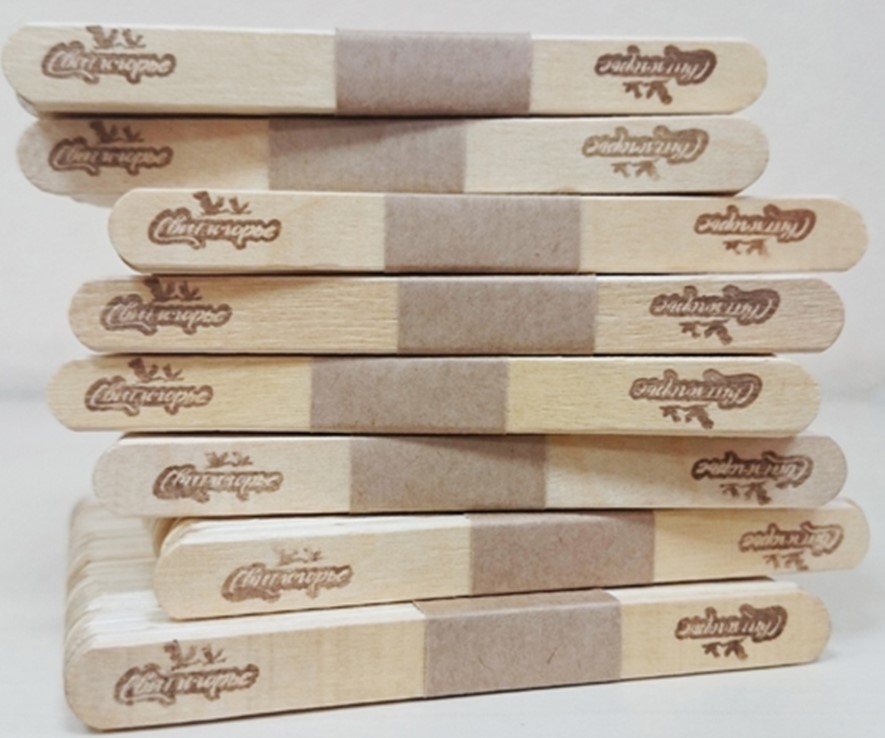 Ice cream sticks (with logo)
 Ice cream sticks Magnum (curly)
 Ice cream sticks (round)
 Pepsin whey pork
 Ice cream sticks Standard 93
 Auxiliaries for sugar products
- Wafer cup and cone
- General purpose environment of SPC "Biocompass-S" (Uglich)
- Ice cream sticks Standard 114
- J-Bottom technology
- Petri dish 90 mm
Consumables
 Plastic syringe 150ml
 Dosing syringe, hose attachment
 Non-returnable cup for udder treatment
 Dosing syringe, bottle attachment
 Drencher for feeding calves with a flexible probe
 Acid detergent (20l / 24kg)
- Disposable nitrile gloves (packing 100 pieces)
- Foam cup for udder treatment
- Sticky fly trap, 25cm*10m
- Rubber rings for castration
- Mug for milking the first streams of milk, lengthwise
- Foaming cup for udder treatment
- Udder cleaner after milking (20 l)
- Antibryk
- Liquid soap "Prestige" (yellow, green, red) 5 l
Microbiology
 MicroFast® Microbiological Substrates
 MicroFast® Environmental Listeria Count Plate
 Yeast & Mold Count Plate (cat. no. LR1003) MicroFast® Yeast & Mold Count Plate
 Substrate for determining QMAFAnM (catalog number LR1001)
 Substrate for determining the number of staphylococci (Catalog number LR1005) MicroFast® Staphyloccocus aureus Count Plate
 MicroFast® Enterobacteriaceae Count Plate (cat. no. LR1011)
- MicroFast® Bacillus cereus Count Plate (catalog number LR1010)
- MicroFast® Coliform & E.coli Count Plate
- MicroFast® Lactic Acid Bacteria Count Plate (Part Number LR1312)
- MicroFast® Staphyloccocus aureus Confirmation Plate Staph.aureus Confirmation Plate (cat. no. LR1005Q)
- Coliform Count Plate (catalog number LR1002) MicroFast® Coliform Count Plate
- Substrate for accelerated determination of QMAFAnM, (catalog number LR1321)
- MicroFast® Salmonella Count Plate (SAL), for the determination of Salmonella in food and environmental samples (Catalog #LR1006)
Our News
 Lukashenko heard a report on the Mogilev region. The main topic was the situation in agriculture. 05.02.2026
 What major agricultural projects are being implemented in the Mogilev region?05.02.2026
 An expert identified possible areas of cooperation between Belarus and Southeast Asian countries.05.02.2026
- Surcharges on prices for agricultural products purchased from the population have been established in 2026.04.02.2026
- Lukashenko: We won't carry the Vitebsk region on our shoulders.04.02.2026
- Baby Zabava. The Grodno Zoo welcomed its first addition in 2026. 03.02.2026
- Lukashenko: We won't carry the Vitebsk region on our shoulders. 03.02.2026
- Lukashenko on the case: it is a moral monstrosity if we cannot protect our smaller brothers in this weather03.02.2026
- Grain cultivation and livestock farming. Bogdanov discussed prospects for cooperation in the agricultural sector between Belarus and Kazakhstan.01.02.2026
- Выпойка молоком 3-4 раза, больше теплой воды. Как в Брестской области наладили уход за телятами в морозы01.02.2026
- From Tractor Driver to Businessman: The Story of a Belarusian Who Built a Farm from Scratch and a Church in a Village 30.01.2026
- A warehouse in the Minsk region improperly stored powdered milk: a court ordered compensation of Br2 million.30.01.2026
- Increased processing volumes, new jobs: production capacity is being expanded in the Shklov district.30.01.2026
- The story of a Belarusian who built a sturdy farm from scratch and revived his native village.29.01.2026
- Belarusian producers plan to enter the Qatari meat market.29.01.2026
- Belarus is interested in expanding dairy product supplies to Indonesia.28.01.2026
Articles
 The court refused to seize the property of agricultural enterprises with debts to the AIC fund.05.02.2026
 Demand for semi-finished products will decline in 2025: dumpling sales will fall by 8%.05.02.2026
 Rosselkhoznadzor inspected more than 2,000 tons of livestock products shipped to Yakutia.05.02.2026
- Rosselkhoznadzor monitored the export of more than 57,000 tons of veterinary goods from St. Petersburg.05.02.2026
- К госветнадзору Бурятии поступило 860 тонн продукции при отправке в Монголию05.02.2026
- The inflation rate in Russia at the beginning of February 2026 reached 6.5%.05.02.2026
- Innovations in broiler feeding: savings and bird health05.02.2026
- New financial disputes between Aventa and Tokarevskaya Poultry Farm: a second lawsuit for 70 million rubles05.02.2026
- Mexican and Canadian beef is losing ground in the US market.05.02.2026
- Spain strengthens institutional coordination to improve animal welfare management05.02.2026
- Blaming cows was a mistake: meadows absorb more gases than cattle emit.05.02.2026
- EU and Mercosur: Experts warn of shortage of EU veterinarians to control imports and associated health risks05.02.2026
- Rosselkhoznadzor stopped the import of more than 50 kg of dangerous animal products at Ufa Airport.04.02.2026
- Rosselkhoznadzor specialists have identified quality violations in meat products.04.02.2026
- The first batch of canned meat from the Kurgan region was sent to Azerbaijan under the supervision of Rosselkhoznadzor.04.02.2026
- A poultry farm in Yugra was fined for violating veterinary regulations.04.02.2026
Economics
 10 reasons to take a deposit04.05.2025
 Lavrov and the Swiss Foreign Minister will discuss the "deep crisis" of the OSCE.05.02.2026
 Kirilenko spoke about the problems facing Russian teams after sanctions were lifted.05.02.2026
- Lavrov believes that US statements about cooperation are inconsistent with sanctions05.02.2026
- The Russian ambassador warned of a reaction to the Faroe Islands' change in stance on sanctions.05.02.2026
- Five suspects in supplying weapons to Russia's defense industry have been arrested in Germany.03.02.2026
- Bloomberg узнал о планах ЕС по санкциям против российских платины и меди03.02.2026
- The EU confirmed discussions on banning entry for participants in the military operation.31.01.2026
- Bloomberg has revealed a new possible EU sanctions plan against Russia.31.01.2026
- The EU has blacklisted Russia for money laundering.30.01.2026
- The EU has imposed new sanctions on Iran in response to the suppression of protests.30.01.2026
- The European Union has designated the IRGC a terrorist organization.30.01.2026
- The US has eased sanctions and allowed oil companies to operate in Venezuela.30.01.2026
- Titov allowed for the return of foreign companies that "miss Moscow"30.01.2026
- Following the deal with Carlyle, LUKOIL continued negotiations with other companies.29.01.2026
- Macron announced that France is preparing new sanctions against Russia.29.01.2026
Antibiotics in Milk
 Antibiotics in milk: causes and methods of detection27.01.2026
 Pharmaceutical companies see a threat to EU security due to bacteria in Ukraine13.11.2025
 Prosecutors have issued warnings to more than 5,000 companies due to rising prices.09.09.2025
- Two dairy companies from Azerbaijan refused to work with Russia.09.07.2025
- Lukashenko told how Putin treated him to goat's milk.08.07.2025
- Lukashenko demanded that Belarus be cleared of littered logs by autumn.08.07.2025
- Lukashenko stated that it is not beneficial for Belarus to “fight madly,” but to feed17.06.2025
- В Британии предупредили о риске для миллионов из-за супербактерий06.01.2025
- Moscow court sides with Indian company in dispute with Health Ministry26.11.2024
- Scientists estimate increase in mortality due to drug-resistant bacteria29.10.2024
- Antibiotics for livestock and pesticides found in poisoned family's home29.10.2024
- Izvestia reported on the shortage of widely used antibiotics in Russia29.10.2024
- The Ministry of Health called data on the shortage of antibiotics unreliable29.10.2024
- Scientists warn of threat of return to pre-penicillin times29.10.2024
- The Ministry of Health explained how attitudes towards antibiotics changed during the pandemic07.05.2024
- WHO explains the risks of taking antibiotics "just in case"06.05.2024
Antibiotics in Meat
 Antibiotics in pollock25.02.2024
 Antibiotics in herring: myth or reality?12.02.2024
 Antibiotics in perch10.02.2024
- Antibiotics in sprat: facts and myths10.02.2024
- Antibiotics in tuna: an important health and environmental issue09.02.2024
- Antibiotics in meat30.01.2024
- Antibiotics in chebureks: myth or reality?29.01.2024
- Antibiotics in cutlets: problem or myth?18.01.2024
- Antibiotics in Chicken: Where Are the Highest Concentrations?17.01.2024
- Antibiotics in carp17.01.2024
- Where Are More Antibiotics in Chicken: Reality and Cautions16.01.2024
- Antibiotics in Salmon: Safety and Product Quality16.01.2024
- Antibiotics in Turkey15.01.2024
- Antibiotics in Sal: Reality and Safety Issues15.01.2024
- Antibiotics in Fried Dumplings: Facts, Risks and How to Stay Safe15.01.2024
- Antibiotics in sausages14.01.2024
10 Interesting Facts
 Antibiotics in Coffee: Myths and Reality03.05.2025
 Forged forks: 10 interesting facts16.05.2024
 Swimming pool and weight loss: 10 interesting facts10.03.2024
- Tests for antibiotics in milk - 10 interesting facts07.03.2024
- Cleaning the kettle from scale, 10 interesting facts...06.03.2024
- Antibiotics in beer: 10 interesting facts04.03.2024
- Wild boar, how to survive...01.03.2024
- Purulent mastitis, 10 interesting facts27.02.2024
- Lemon and alcohol: 10 interesting facts25.02.2024
- Mint - 10 interesting facts25.02.2024
- Wild boar, 10 interesting facts20.02.2024
- Wild boar and domestic pig: comparison and advantages20.02.2024
- Cottage cheese, 10 interesting facts20.02.2024
- 10 Interesting Facts About Milk19.02.2024
- How to Clean a Toilet - 10 Interesting Facts (Acid vs Alkaline)18.02.2024
- Goat's milk: 10 interesting facts16.02.2024
Diseases of cattle
 Dicroceliosis in cattle09.03.2024
 Demodicosis in cattle01.03.2024
 Purulent mastitis of cattle27.02.2024
- Hypodermatosis in cattle20.02.2024
- Hemonchoz in cattle11.02.2024
- Bursitis in cattle30.01.2024
- Brucellosis in cattle29.01.2024
- Bronchopneumonia in calves27.01.2024
- Bronchitis in cattle26.01.2024
- Mortellaro disease in cattle24.01.2024
- White muscle disease in cattle23.01.2024
- Babesiosis in cattle22.01.2024
- Cattle acidosis20.01.2024
- Arthritis in cattle20.01.2024
- Anaplasmosis in cattle18.01.2024
Misc
- Antibiotics for coughs: when they are needed and when they are not11.02.2024
 "Слетают все маски человека!" // Банщик про техники парения, поющих мастерах и чудо-массажах05.02.2026
 The Master of Steam: The Story of a Businessman Who Left a Successful Printing Business to Become a Spa Master 05.02.2026
- Investigators have identified the locations of the most frequent traffic accidents in the Brest region.05.02.2026
- Ministry of Emergency Situations: 129 people have died in fires since the beginning of the year.04.02.2026
- WHO: Almost 40% of cancer cases can be prevented 04.02.2026
- The number of fires in Belarus has increased. Experts have explained the causes.04.02.2026
- "Neither tail nor scales." We went winter fishing and learned the intricacies of ice fishing.04.02.2026
- Belarus has extended the ban on labeling imported alcoholic beverages in unfriendly countries.03.02.2026
- В Гомеле благодаря неравнодушным гражданам остановили нетрезвых таксиста и бесправника 03.02.2026
- From February 11, navigation seals will be used to track rail traffic in the EAEU.03.02.2026
- The State Traffic Inspectorate reminded drivers of road safety rules during severe frosts.31.01.2026
- A woman driving under the influence of alcohol with over 2 ppm was detained in Minsk.30.01.2026
- Наведение порядка в АПК, пожарная безопасность. Какие задачи поставлены перед прокурорами Витебской области 30.01.2026
- A car crashed into a tree on Independence Avenue in Minsk, injuring two people.30.01.2026
- Топ экспортируемых товаров назвали в "Белгоспищепроме"29.01.2026
Cloud of Tags
ГерманияСвининаЭкспортОнлайнУкраинеВеликобританияИсследованияПитаниеМясо птицыЦеныGoogleЛечениеТАССАзербайджанОтпускРоссельхознадзорБройлерМолокоПоддержкаTelegramЕгипетУченые2024Крупного рогатого скотаАлкогольного опьяненияЖивотноеДональд ТрампРодителиДиректорТребованияВыручкаЗаконопроектДжо БайденУрожаяБизнесИнфляцияМясокомбинатИммунитетКРСДмитрий песковУзбекистанИталияАЧССырыКризисМясоПтицефабрикаВеликобританииПродовольствиеКредитРоссиянеВакцинацияВластиReutersКоронавирусДеньгиСпутник vГовядинаМинскСШАФруктыFacebookТатарстанВладимир ПутинПесковУкраинаТурцияЭкономикаСубсидииПензенской областиКарантинПравительствоПольшаЕСАлександр ЛукашенкоПроизводство мясаАвстралияУборкаМужчиныИмпортБразилияСудЯйцаЯпонияОрганизмЗаконЛекарстваНедвижимостьМаслоМинфинминистр сельского хозяйстваСанкт-ПетербургПрокуратураЕврокомиссияЦентробанкКрупный рогатый скотДетиПодмосковьеРоспотребнадзорRussiaИнвестицииАнтибиотиковЗависимостьПраздникВакцинацииCOVID-19КартофельНефтьПродукты питанияВьетнамКанадаРаботаФранцияРоссияЕАЭСГазпромВ китаеСмертьКитайКофеКлиматВирусМЧСКолбасыФермерПродукцияДолларЗеленскийЗдоровьеСанкцииСотрудники ГАИПроизводство молокаКазахстанBloombergЗапретБеларусьДоходыБолезньНовостиГовядинуОбщепитВостокМинздравРубльМинсельхозAppleМоскваАлкогольРосстатСельское хозяйство